How to Get an IYT Yacht Licence
The IYT Bareboat Skipper plastic certificate confirms that you are qualified to operate a sailing yacht up to 24 metres in coastal waters. Charter companies in the Mediterranean, the Caribbean and Southeast Asia ask for it when you rent a yacht without a professional skipper.
Which Certificates You Will Receive
A yacht licence is a general term used for certificates that confirm a person’s competence to operate a yacht. For independent yacht charter, the required certificate depends on the country, charter company, cruising area and type of yacht. The most widely recognised international certification systems include IYT, RYA and ISSA.
Graduates of our school receive the IYT International Bareboat Skipper certificate. It confirms that the holder has the knowledge and practical skills required to skipper a sailing yacht up to 24 metres within the limits of the certificate. Our courses are designed for complete beginners, so no previous sailing experience is required.
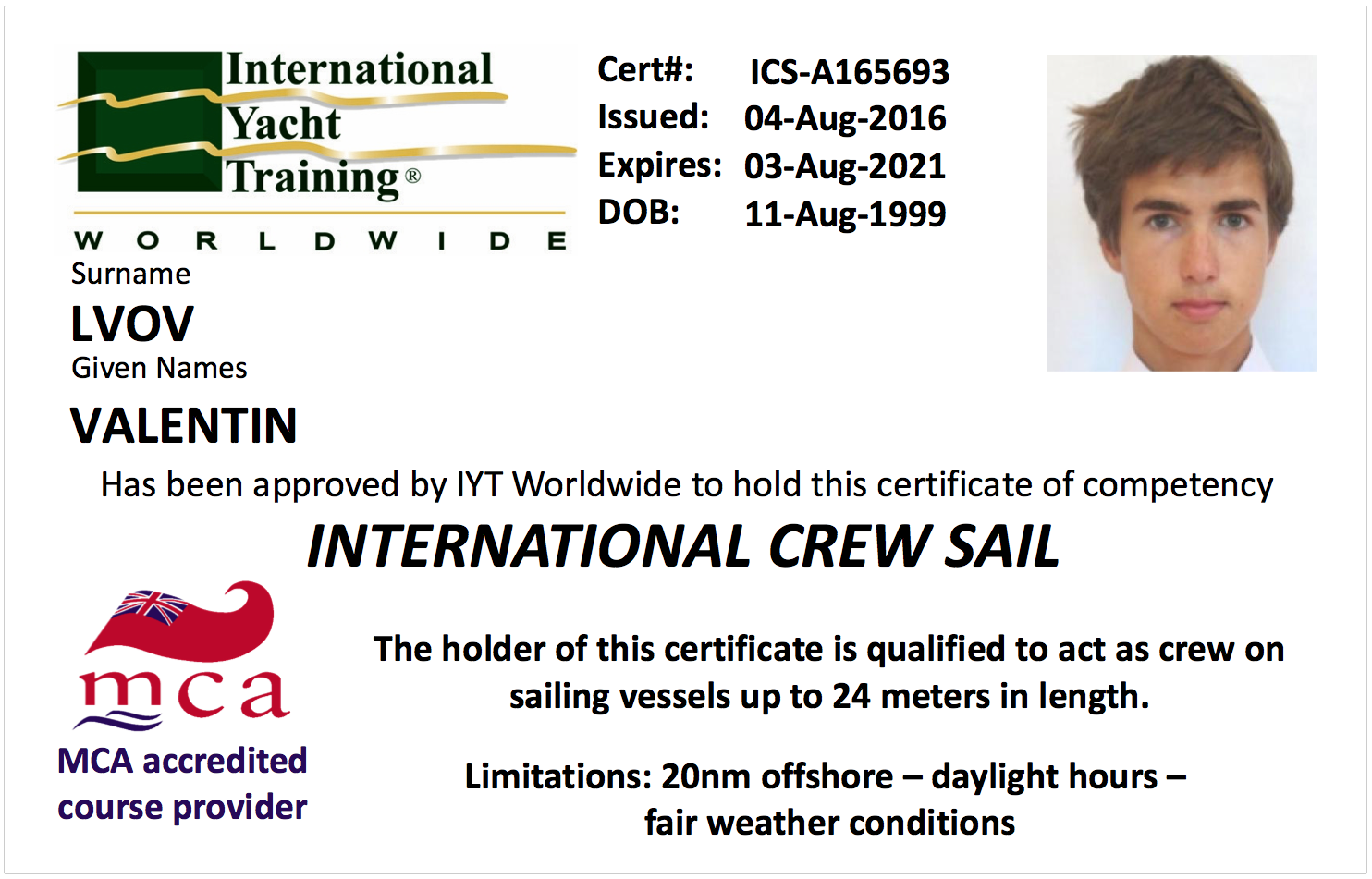
Competent Crew
A certificate for a trained crew member covering sail handling, mooring, basic navigation and life on board. It is useful for joining a crew, but it does not allow you to charter and operate a yacht independently.
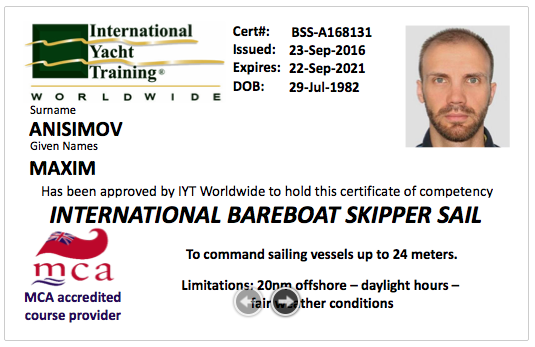
Bareboat Skipper
Qualification to independently operate a sailing yacht up to 24 metres in coastal waters. This certificate is usually required when you rent a yacht without a professional skipper in Croatia, Greece, Turkey or the Caribbean.
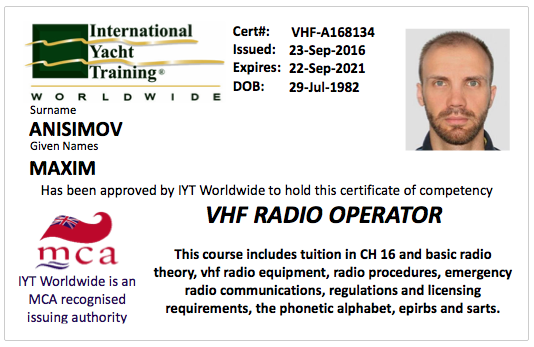
VHF Radio Operator
A VHF radio operator certificate. In most European countries, a charter company will not release the yacht without it because the skipper needs a licence to use the onboard radio.
| Document | Yacht type | Where it is relevant | Who needs it | How to obtain it |
|---|---|---|---|---|
| IYT Bareboat Skipper | Sailing yachts up to 24 metres in coastal waters | Mediterranean, Caribbean and Southeast Asia | People who want to charter a yacht without a professional skipper | Complete practical training, pass the exam and receive the IYT certificate |
| IYT VHF/SRC | Marine radio equipment on a charter yacht | Especially important for yacht charter in Europe | The skipper responsible for operating the yacht's marine radio | Complete separate training and pass a marine radio communication exam |
| IYT YachtMaster Coastal | Yachts used for more demanding coastal passages | Longer coastal passages and advanced skipper training | Skippers who already have sufficient practical experience | Complete the required training and provide evidence of sufficient practical experience |
| ISSA / RYA | Depends on the certificate level | International sailing schools and yacht charter markets | People who choose an alternative international certification system | Complete training through a school accredited by the relevant certification system |
In brief.If your goal is to obtain a yacht licence for bareboat charter abroad, the main certificate you need is the IYT Bareboat Skipper. A VHF/SRC certificate is an additional qualification that confirms you are allowed to operate marine VHF radio equipment.
Where the IYT Licence Is Accepted
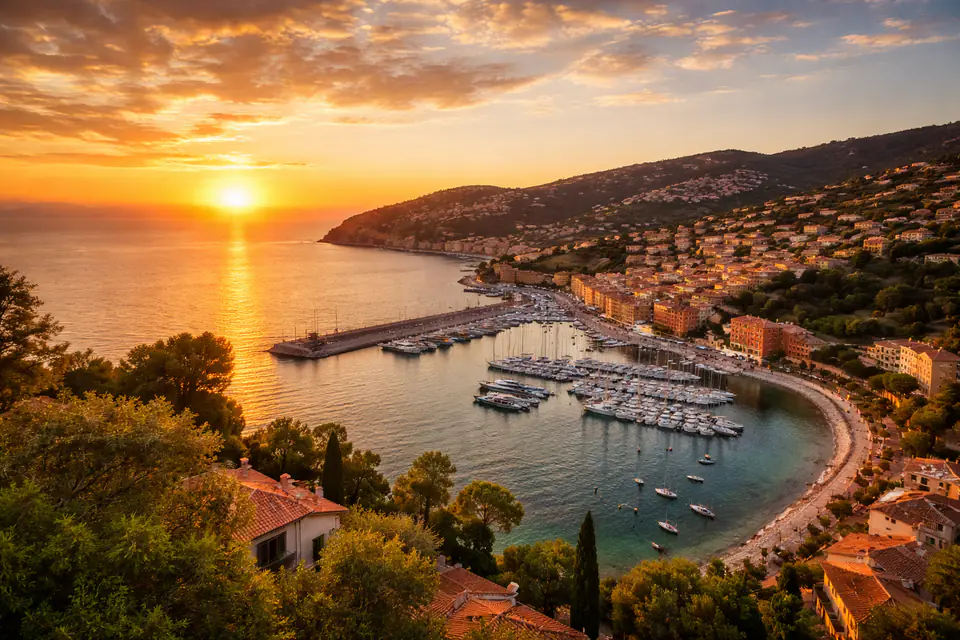
IYT is one of the three largest international yacht certification systems. It is recognised by charter companies and port authorities around the world.
- Mediterranean: Croatia, Greece, Turkey, Italy, Spain, France
- Caribbean: British Virgin Islands, Saint Martin, the Grenadines, Martinique
- Southeast Asia: Thailand, Malaysia, Seychelles
- Atlantic and northern regions: Canary Islands and the Baltic Sea within Schengen countries
Some countries may also require an ICC or a national certificate. If your route is outside the standard Mediterranean charter areas, we will explain exactly which documents are required for the specific sailing area.
What Are the Limitations of Bareboat Skipper?
Bareboat Skipper is not a commercial captain’s licence and does not provide unrestricted permission for ocean passages. Its purpose is to confirm that you can operate a charter sailing yacht up to 24 metres in coastal waters. Longer passages, paid work as a skipper or sailing in difficult tidal areas may require a higher qualification, additional practical experience or local validation.
How to Obtain a Yacht Licence: From Training to Certification
An IYT yacht licence is obtained after completing practical training and passing an exam. This is what gives the certificate its value: a charter company needs evidence of a skipper’s verified competence, not a purchased document.
-
01
Application and date selection
We discuss your goals, select a 7, 11 or 14-day format and choose an available date. No previous experience on board is required.
-
02
Practical training on the yacht
Theory is immediately practised on board: sail handling, mooring, navigation, radio communication and the skipper’s everyday duties. You live on the yacht with the group and the instructor.
-
03
Exam
The practical part takes place on the water and includes mooring in wind, a man overboard manoeuvre and sail handling. It is followed by an oral theory assessment. 95% of students pass on the first attempt.
-
04
Receive your IYT certificate
The certificate application is sent to the IYT office in Canada, and you receive a personalised plastic certificate. You can use it when booking a charter and to confirm your qualification as skipper to the charter company.
To understand which training format leads to the IYT Bareboat Skipper certificate, see the skipper training programme. This page explains certificates, licences and charter requirements.
How Much Does an IYT Yacht Licence Cost?
The total cost includes practical training on the yacht, the exam and the issue of the plastic IYT certificate. The table below explains the price structure so that you can clearly see what is included and what must be confirmed separately before booking specific dates.
| Item | Included / separate | Cost / conditions | Where to confirm |
|---|---|---|---|
| IYT Bareboat Skipper | Practical training, instructor, yacht and exam | €850 / €1,250 / €1,400 for 7 / 11 / 14 days | Detailed prices |
| Issue of the plastic certificate | Paid separately | About €250, depending on IYT in Canada | Confirm before booking |
| VHF/SRC | Separate radio operator certificate | Included in the course price | No confirmation required |
| Additional practical training | Only if additional skills are needed before the exam | Based on the actual training format | After assessment by the instructor |
| Practice charter | -- | Graduates may receive a discount of up to 35% | Depends on the specific yacht and dates |
About the issue of plastic certificates. To obtain a yacht licence, you must first complete the training and pass the exam. The application for the IYT certificate is then submitted. Production and delivery usually cost about €250, but it is better to confirm the current amount with a consultant.
For a complete price calculation, including accommodation on board, crew meals, transfer and the conditions of the discount on your first charter, see the dedicated pricing page.
Why You Can Obtain Your Licence with Confidence
The certificate is not the most important thing you receive after the course. What matters most is the confidence that you can charter a yacht and operate it safely. This is why our training process is organised as follows.
Certificate issued directly through IYT
After you pass the practical exam, IYT issues the certificate in your name. The qualification is earned through training and assessment rather than purchased as a separate document.
Real Practical Examination
The instructor assesses the practical part in real sailing conditions. It includes mooring, a man overboard manoeuvre, navigation and sail handling.
Our own fleet and experienced skippers
Four cruising yachts owned by the school and instructors with racing and charter experience, not seasonal trainees. Meet the instructors who conduct the exams →
How IYT differs from RYA and ISSA
If you are looking for a yacht licence, it is important to understand the differences between the main international certification systems. IYT, RYA and ISSA all provide skipper training, but they follow different training standards and certification programmes.
International charter
The IYT Bareboat Skipper certificate is widely accepted by charter companies around the world. It confirms that you have the knowledge and practical skills to charter and skipper a sailing yacht without a professional captain.
British training system
RYA is a well-known yachting training and certification system developed in the United Kingdom. Its certificates are respected internationally and are accepted by many charter companies.
International training system
ISSA is another international yacht training and certification system. Before choosing IYT, we carefully compared all major training systems and selected the one that best matches our educational standards and practical approach.
Before you book. Always check the charter company's requirements in advance. Some companies may also require a VHF/SRC certificate or additional local documentation, depending on the country and cruising area.
What to Read Next
Which Course You Need for the Licence
How the 7, 11 and 14-day training programmes are organised: what you learn each day and what life on board is like.
VIEW THE PROGRAMME →
Detailed Course Prices
What is included in the course price, what is paid separately and how the discount on your first charter works.
VIEW THE PRICE DETAILS →
Who Teaches You and Conducts the Exam
Skippers with racing and charter experience. Their qualifications and sailing miles are presented openly and clearly.
MEET THE TEAM →Frequently Asked Questions
No. The Bareboat Skipper course is designed for complete beginners, with theory and practical training taking place together on board. Most students arrive without previous sailing experience and leave after earning their certificate. The most important requirements are a willingness to learn and readiness to spend one or two full weeks on the yacht.
Countries that recognise the IYT system include virtually all major yacht charter destinations: Croatia, Greece, Turkey, Italy, Spain, France, the Caribbean, Thailand, Malaysia and the Seychelles. In some jurisdictions, a charter company may also require an ICC or a national certificate. If your planned route is outside the standard charter areas, we will advise you in advance exactly which documents are required for your specific cruising region.
The course itself takes from 7 to 14 days, depending on the selected format. After you pass the exam, the certificate application is sent to the IYT office in Canada. The personalised plastic certificate usually arrives within 4–8 weeks. Before it arrives, you receive electronic confirmation, which is already accepted by many charter companies.
The course price includes training on board, instruction, yacht use for the full programme and fuel for the planned route. The following are paid separately: the IYT plastic certificate, approximately €250, shared crew meals, flights and transfer to the marina. A detailed price structure is available on the training page.
Bareboat Skipper is the main course leading to the qualification required to operate a charter yacht independently. Competent Crew is training for crew members and does not allow the holder to operate the yacht alone. YachtMaster Coastal is an advanced qualification for offshore passages and longer routes and is taken after the skipper level.
A licence is almost always required for an independent charter without a professional skipper. Without a certificate, the charter company may refuse to release the yacht, even if you have experience. The exception is a charter with a hired professional skipper, where you are not the responsible skipper under the charter agreement.
Yes, if you rent the yacht as a bareboat charter, meaning without a professional skipper. The charter company usually asks for a skipper certificate, passport, sailing experience and sometimes a VHF/SRC radio operator certificate. It is best to check all requirements before booking.
In many European marinas, a separate VHF/SRC certificate is required because the yacht has an onboard radio. Bareboat Skipper confirms your qualification to operate the yacht, while VHF/SRC confirms your qualification to use marine radio communications. This document is especially important in Croatia and several other destinations.
You usually need your passport, IYT Bareboat Skipper certificate, VHF/SRC if required for the sailing area, proof of experience and the booking voucher. For a non-standard route, we check the required documents in advance for the country and charter company.
You can retake the exam. 95% of students pass on the first attempt, not because the exam is only a formality, but because the instructor observes your progress throughout the course and does not send you to the exam while there are clear gaps in your skills. If necessary, additional practical training and another exam are arranged.
No. Bareboat Skipper requires practical training and a practical exam on the water. Any remote or accelerated schemes without sea practice are not connected with IYT and are not accepted by reputable charter companies. The certificate is awarded as a result of completing real training; it is not a separate service.
Let Us Discuss Your Licence and the Route to Certification
We will explain which document is suitable for your goal, how much time you should realistically allow, what is included in the price and which additional certificates may be required for your chosen sailing area.
Send an enquiry
We will call you back and answer your questions about the documents, price and nearest available dates.